

A cover letter closing paragraph can quietly undo an otherwise careful application. After explaining relevant experience, you add that you can start immediately, call next week or solve the employer's problem from day one. The sentences sound confident, but perhaps none of those commitments has been checked. Another ending simply repeats the opening and then asks for an interview. The task is not to invent a memorable final flourish. It is to finish this particular argument with a truthful, manageable next step.
This free review method begins with the letter you actually need to send, the vacancy and your own facts. It then shows a concrete CVura workflow for keeping the opportunity, reviewed resume and letter together. CVura publishes this guide; it is not an independent app comparison or a claim that software improves hiring results. Drafting suggestions still require your judgment. The method can also be applied manually, and a free guide does not mean unlimited free use of every app feature.
Give the cover letter closing paragraph one clear job
Read the full letter before editing its ending. Identify what the opening promises and what the middle actually supports. The conclusion should connect that evidence with a reasonable invitation to continue the discussion. It does not need to introduce another qualification, summarize every project or announce that you are the ideal candidate. If a crucial example appears only in the final line, move it into the body where its context can be understood and checked.
For a fictional operations assistant application, the body might explain how you maintained a handover record during a training placement. The close could invite a conversation about applying that experience to the role's coordination tasks. It should not suddenly claim that you transformed an entire department or can eliminate errors. The example remains modest because the underlying work was modest. Confidence comes from describing your actual contribution clearly, not from making the last sentence bigger than the evidence.
Separate the closing paragraph from the sign-off. The paragraph completes the professional argument; a conventional sign-off and name finish the document. Neither requires a new biography or a decorative slogan. Harvard's cover-letter guidance includes interest in a further conversation and thanks in the close. Treat that as a structural reference, not a requirement to promise a follow-up call regardless of the employer's process or your actual intentions.
Check the role, evidence and submission instructions together
Keep three things visible: the vacancy, the reviewed resume for this opportunity and the current letter. Check the company, role title, reference and recipient before polishing the final paragraph. A copied employer name can survive many rounds of sentence editing. Read the submission instructions too. If the employer asks for a short answer in a form instead of a letter, answer that question; a polished closing paragraph does not override the requested format or create a reason to attach an unwanted document.
Choose one relevant fact already supported in the letter. Ask what work it shows, what you personally did and why it connects to the advertised responsibility. Do not add a new metric, seniority level or certification merely because a draft sounds stronger with it. If a statement cannot be explained under normal follow-up, remove or correct it. The closing paragraph may interpret the evidence, but it cannot manufacture a different career history from the one your resume presents.
In a short private note, distinguish facts from decisions. The advertised task is a source fact; the reason you want to discuss it is your decision. Immediate availability is another factual claim that needs its own check. Keeping these categories separate prevents a plausible sentence from quietly becoming an unsupported promise. The record can be brief: relevant responsibility, supported example, useful next step, and any practical information the employer explicitly requested in the letter.
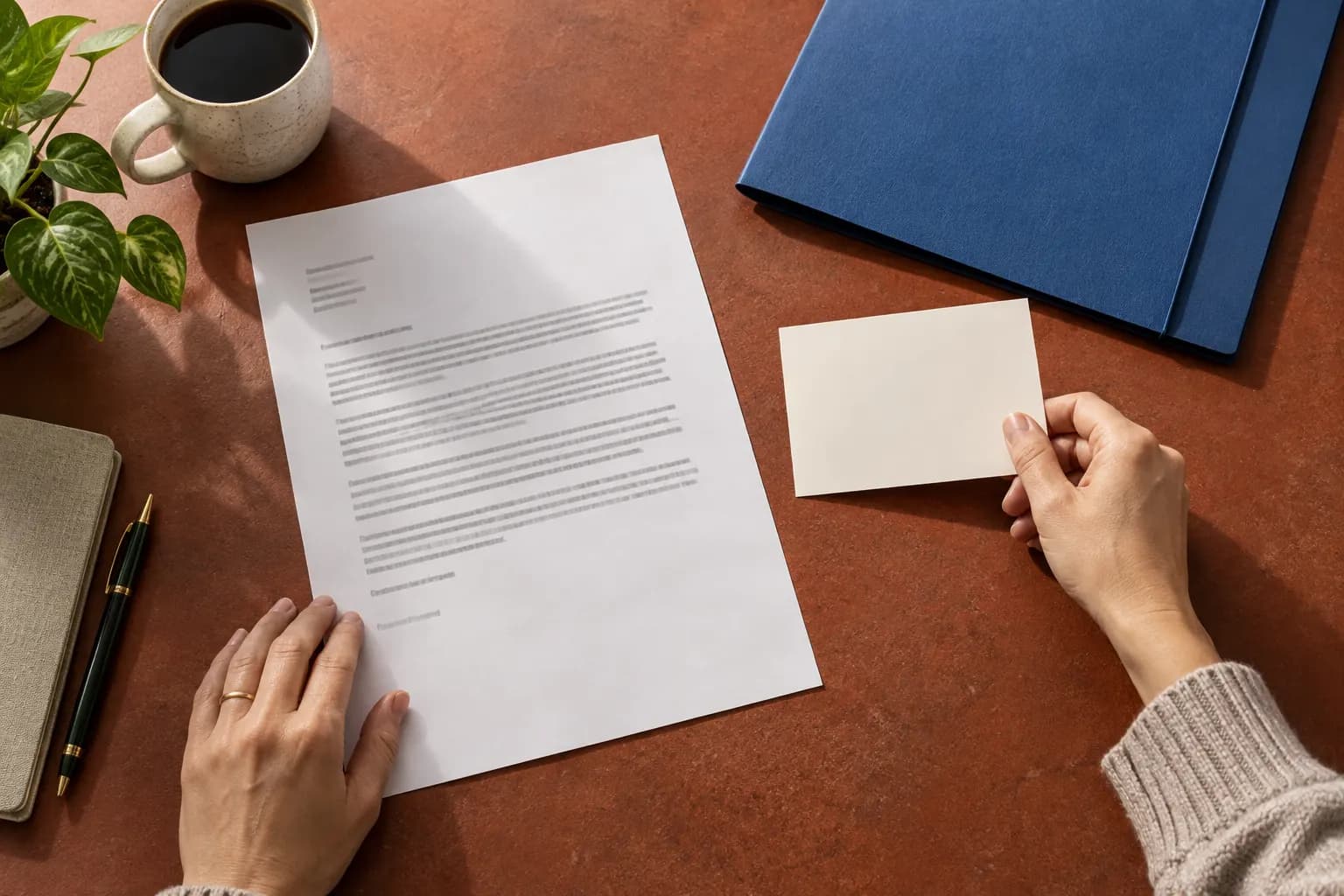
Use CVura to keep this draft tied to the right opportunity
Open the saved opportunity and confirm that its job brief describes this application, not a similar vacancy at the same organization. Connect the resume version you have reviewed for the role. In the cover-letter workflow, use that role context and your genuine motivation to prepare a focused draft. Keep the ending narrow: relevant connection, proportionate invitation and accurate practical details when needed. Do not paste confidential employer material or private third-party information that the application does not require.
Review the source career facts before treating any proposed wording as usable. Importing a document or saving a career foundation does not independently verify its contents. Correct names, dates, scope and contribution yourself. A draft may turn assisted work into ownership or convert an interest into claimed expertise. Compare every substantive statement with the reviewed resume and your evidence. Saving both documents in the same workflow helps you compare them; it does not prove that they are consistent automatically.
Replace grand claims with a specific invitation to talk
A useful ending can be two short sentences when the rest of the letter has done its work. For the fictional coordination example: I would welcome the opportunity to discuss how my experience maintaining clear handover records could support this role's coordination work. Thank you for considering my application. This is an illustration to adapt, not a sentence to copy into every letter. Its meaning depends on genuine experience and an actual responsibility described in the vacancy.
Compare that with: I am the perfect candidate and will transform your operations immediately. The second version asks the reader to accept conclusions the application may not support. Remove guarantees about performance, selection or an interview. Replace vague superlatives with the work you can explain. If the body already made the same connection clearly, shorten the close rather than repeating it word for word. An invitation can be confident without insisting that the employer has already agreed with your assessment.
Use a review pass to test each suggested sentence for additions. Does it introduce a new achievement? Does it imply that a meeting has been offered? Does it promise an action you do not intend to take? Mark the exact wording that creates the problem, then rewrite it in your own voice. Do not ask a draft merely to sound more persuasive while leaving the underlying claim unchecked. Style is the final adjustment, not a substitute for the factual decision.

Distinguish interview availability from a possible start date
Being willing to discuss the role is not the same as being able to start work immediately. If the employer asks for a start date, check your real commitments and the instructions before stating one. Do not copy immediately available from a model because it sounds decisive. If you cannot yet provide a reliable date, say what you can accurately establish or use the requested channel to clarify. This guide does not assess notice periods or give legal advice about leaving employment.
Similarly, available at any time is a broad commitment. You can express interest in arranging a conversation without promising every hour of every day. If specific windows are requested, provide checked options in the designated field or message. Avoid duplicating inconsistent dates across the letter and portal. An unnecessary availability sentence can be removed entirely when it adds no useful information. The right close may simply invite further discussion and thank the reader, without turning into a scheduling negotiation.
A planned follow-up is also a commitment. Do not announce that you will call next Tuesday if you have no intention of doing so, no appropriate contact or instructions that permit that channel. Respect a stated process instead of treating persistence as a universal rule. If an invitation later arrives, answer its actual scheduling request. Keep that later agreement distinct from the general interest expressed in the application letter; the conclusion itself does not book an interview.

Keep the tone consistent with the whole letter
Read the closing paragraph aloud immediately after the previous one. A sudden change into ceremonial language, exaggerated enthusiasm or a sales slogan can make the ending feel borrowed. Use ordinary professional language you would be comfortable explaining in conversation. You do not need to apologize for applying or demand an answer. The reader should understand why further discussion could be useful, without being asked to admire your confidence or respond within a deadline you invented.
Remove repeated motivation if the ending adds no new function. A final paragraph that restates the opening, repeats the evidence and then repeats the job title can often be shorter. The opening-paragraph guide covers how to introduce the argument; the close should complete it, not restart it. Check for a second introduction disguised as a summary. Keep any final reference to the work brief enough that the actual invitation remains easy to recognize.
Use a sign-off appropriate to the language and correspondence, then check your name. Avoid importing a foreign-language formula literally because it sounds impressive in a model. A signature image, if used, does not correct an inaccurate name or recipient elsewhere in the file. Check the employer's requirements for the actual submission. Do not add several alternative sign-offs or drafting notes to the outgoing letter; choose the version you intend the recipient to read.
Inspect the exported letter, not only the editing screen
After revising, export the requested format and open the actual output. Read the final paragraph with its preceding text, sign-off and name. Look for a stranded signature, an extra page, a missing line or a conclusion copied from an older version. Do not reduce the text to an unreadable size merely to hide an overlong letter. Cut redundant language first and check the whole document again. A clean editor view does not establish that the exported file is complete.
Compare the letter and resume one last time for employer names, role context, dates and scope. Check any statement about attachments against what you are really sending. Do not say a portfolio or reference letter is enclosed when it is not part of the requested package. In CVura's application organization workflow, keep the reviewed documents associated with the same opportunity. Use the record to identify the pair, then personally inspect the files selected for submission.
If the employer uses a text field rather than an attachment, review the pasted text in that field and any character limit. A letter's sign-off may need a different presentation from a short form answer, but the facts must remain the same. Follow the form's question rather than pasting a full letter into every box. Check that truncation has not removed the sentence that explains the next step or left an unfinished phrase at the end.

Retain the exact close you sent and stop revising that copy
Keep the submitted letter with the opportunity, the corresponding resume and the available submission confirmation. A later improved draft should not replace your record of what the employer received. This matters if the conclusion mentions a start date, a particular project or a planned contact. You may need to explain that statement later. The record is useful for your own accuracy; it does not show that the recipient opened the file or accepted the proposal in its final paragraph.
If you discover an error after submission, distinguish a stylistic preference from a factual mistake. A sentence you now find slightly formal is not the same as promising a date you cannot meet. Check the employer's correction process before sending replacements. When a correction is necessary, identify the change clearly rather than issuing repeated revised attachments with no explanation. Keep any permitted replacement alongside the original record so that you know which message changed the information.
Before the next application, reuse the method rather than an unchecked ending: inspect the role, select supported evidence, draft in context, review every promise, check tone and inspect the actual output. Keep the close proportionate to the rest of the letter. CVura can hold the relevant application context, but you remain responsible for the facts and the submission. A useful ending leaves a clear path to a conversation without pretending that the conversation, start date or hiring decision has already been agreed.