
A free master resume workflow solves a problem that appears after the first few applications: your best evidence becomes scattered across old files, dates drift between versions, and you can no longer remember which wording an employer received. The solution is not one universal resume. It is one complete, verified career record that feeds a separate, focused document for every serious opportunity.
The master document may be several pages long because it is not meant to be submitted. It stores roles, projects, education, certifications, tools, outcomes, and useful context while the details are still available. Each application version is shorter and selective. CVura can support the same process by keeping the professional foundation, role review, resume version, and application context connected, but the method also works with ordinary files and folders. The important rule is to preserve the source before tailoring the presentation.
Start the free master resume workflow with a complete record
Begin with collection, not design. Gather previous resumes, performance notes, project summaries, certifications, course records, portfolio links, and accurate employment dates. Add paid work, internships, volunteering, freelance projects, and substantial academic work when they contain evidence that could matter later. The source document can be untidy while you collect; completeness matters before elegance.
For every role or project, record the official title, organization, location or working arrangement, start and end dates, responsibilities, collaborators, tools, constraints, and outcomes. Separate what you personally owned from what the team delivered. Save numbers only when you can trace them to a report, dashboard, review, or reasonable record. If the exact figure is unavailable, describe concrete scope instead: three regions, a weekly process, twelve stakeholders, or a regulated environment.
Clark College Career Services describes a master resume as one place for all skills and experience, without the length limit of a submitted resume. Treat that record as private working material. It may contain detail that no employer needs, so do not upload or submit it by accident. Use an unmistakable name such as Career-Record-Source rather than Resume-Final.
- Verified dates, titles, education, and credentials
- Projects, responsibilities, tools, and collaborators
- Results, scope, and the source behind important numbers
- Useful stories that may support future interviews
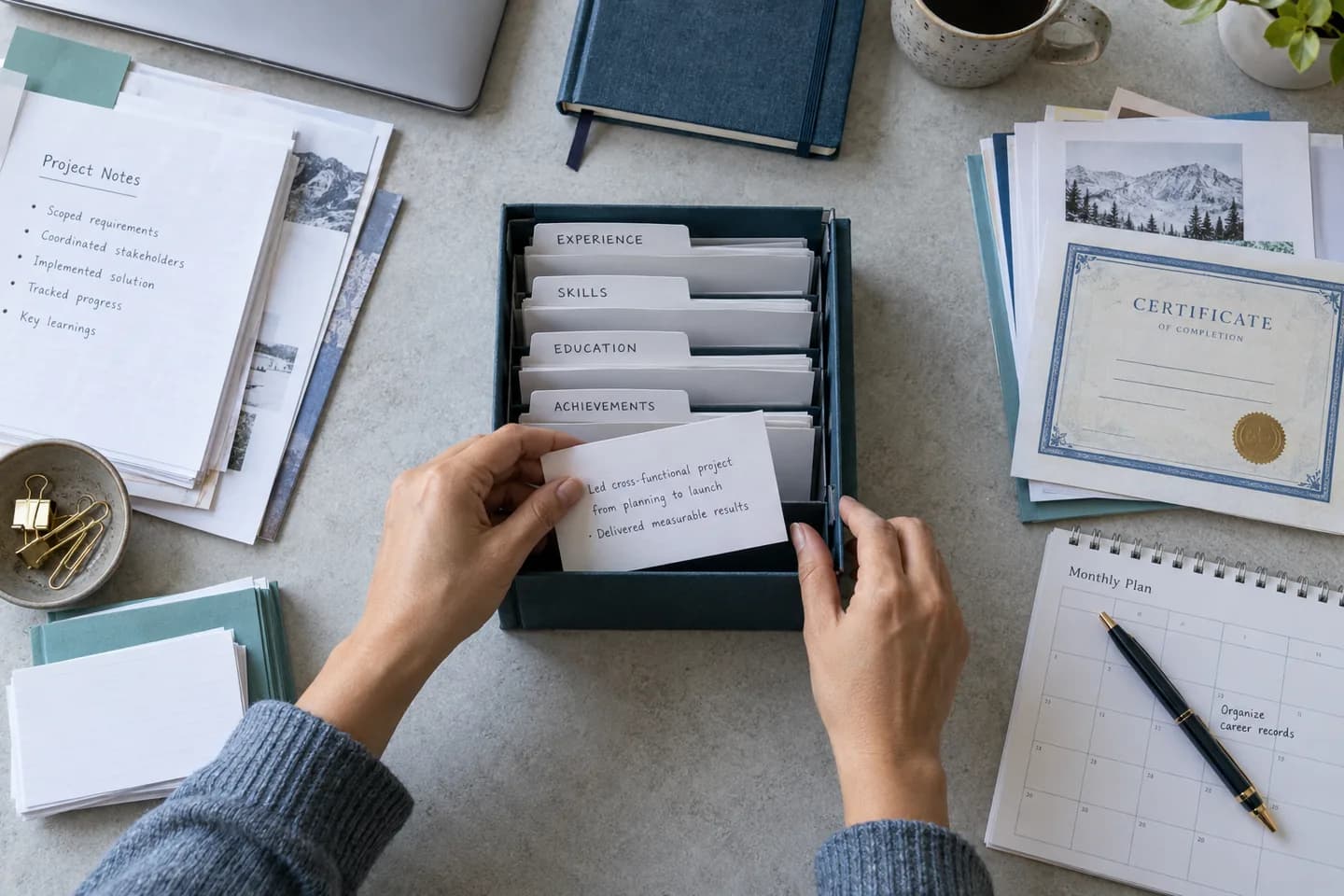
Store evidence in reusable units, not finished slogans
A useful master resume is more than a long list of polished bullets. Store each strong example as a small evidence unit: situation, responsibility, action, result, and source. Add the skill or job need it may support, but do not force one label permanently. The same project might demonstrate analysis for one role, stakeholder communication for another, and process improvement for a third.
Keep the factual core separate from the phrasing. For example, the source record might say that you redesigned a weekly intake process with support and operations, reduced repeat questions from 42 to 27 in the following month, and documented the change in a service report. A targeted resume can emphasize coordination or process design, but the people, period, and result remain fixed. This separation allows relevant writing without quietly changing history.
Review uncertain entries immediately. Mark estimates, team results, confidential information, and outcomes that need permission or anonymization. Remove customer names, internal financial details, and sensitive project data from any public facing version. A smaller claim you can explain is more useful than a dramatic statement you have to soften in an interview. The master record should make verification easier, not become a storehouse of unchecked claims.
Create a role brief before creating a resume version
Save the vacancy before editing anything. Record the employer, job title, location, posting link, deadline, and the full description or a permitted copy. Then reduce the posting to a role brief: the purpose of the position, three to five important outcomes, essential conditions, recurring capabilities, and useful context. Repetition across the summary, responsibilities, and qualifications is usually a stronger signal than one fashionable adjective.
Mark each need as direct evidence, transferable evidence, or a real gap. Direct evidence comes from comparable work. Transferable evidence reaches a similar outcome in a different setting. A gap has no example you could defend. The brief is a decision aid, not a keyword harvesting exercise. It helps you decide whether to apply and which evidence deserves attention without encouraging you to copy unsupported language.
If a required license, location, language level, or security condition is missing, recognize it early. If a preferred platform is missing but you used a comparable tool to solve the same problem, the underlying method may still be relevant. The previous guide explains how to match a resume to a job description without lying. Here, the role brief becomes the bridge between that analysis and a controlled new document version.

Build a focused resume version from the source
Duplicate a clean template and give the new file an identity before changing it: employer, role, and date. Pull only the evidence that supports the role brief. Keep chronology accurate, retain enough context to understand progression, and move the strongest relevant bullets higher within each position. The targeted version is not a summary of everything you have done; it is a truthful argument for this particular decision.
Write the summary last. It should reflect the evidence that survived selection, not an idealized version of the posting. Use the employer's terminology when it accurately names your work, place tools where their use is demonstrated, and keep official titles and certifications exact. An ATS and job match review can flag language worth checking, but no match score proves that every system will parse a file or that a recruiter will advance it.
CVura's resume workspace can keep the career foundation and role focused version in one flow. Start from verified experience, compare the target need with evidence you can support, and review every suggested change before it enters the document. The product should reduce repeated setup, not replace judgment. If a suggestion adds a responsibility, metric, or skill that is absent from the source, reject or rewrite it.
- Name the version before editing
- Select evidence against the saved role brief
- Change emphasis and wording without changing facts
- Review the exported document outside the editor
Use simple version control that survives a busy search
Version control does not require software terminology. Use one predictable filename pattern, one folder per opportunity, and one clear status for drafts. A practical file might be Ethan-Parker-Northstar-Product-Manager-2026-09-08.pdf. Keep the editable source beside it, but mark the exported submission so it cannot be confused with a later draft. Avoid names such as final2-new-reallyfinal because they reveal nothing when several applications are active.
Create a short change note for each version. Record which evidence moved up, which keywords were added because they were accurate, which details were removed, and any question left for an interview. This is especially useful when two roles have similar titles but different priorities. You do not need to preserve every keystroke; you need enough context to reconstruct why the document looks the way it does.
Never overwrite the master record with the shortened version. New verified evidence should move back into the source, while job specific framing stays with the application. This two way discipline prevents the archive from going stale without filling it with employer slogans. Schedule a brief monthly review to update the current role, recent projects, training, and contact details while the facts are easy to confirm.
Attach the exact submitted resume to the application
Once you submit, freeze the evidence package. Save the final resume, cover letter, job description, portfolio selection, and any application questions together. Record the submission date, route, contact, deadline, and next action. If the employer later updates or removes the vacancy, your saved copy preserves the context that shaped the application and the examples you chose.
An application tracker becomes valuable when it connects the opportunity to the actual files rather than storing only a company name and status. CVura is designed around that relationship: the role, tailored material, interview preparation, and next step remain part of the same opportunity. It does not submit applications for you or guarantee follow ups; you still decide what to send and when to act.
The distinction between editable and submitted matters. You may improve your master record tomorrow, but the interview panel will discuss yesterday's version. Open the submitted PDF before a recruiter screen and note any terms that require a concise example. If you discover a minor typo, correct the source for future applications and decide calmly whether the current process truly needs an update rather than sending an unexplained replacement.

Carry the same evidence into interview preparation
The value of the workflow appears after the application. Review the role brief and highlight the evidence already visible in the submitted resume. Build two or three deeper examples around likely areas of discussion: what you owned, the choices you made, obstacles, collaborators, and the result. Do not memorize the resume. Use it as an index to fuller stories stored in the master record.
Prepare for gaps as carefully as strengths. If the resume shows transferable rather than direct experience, practice explaining the bridge without claiming equivalence. If a team result appears, state your contribution and what others owned. If a metric has a limited timeframe, preserve that context. Consistency does not mean repeating identical sentences; it means that every version of the story points back to the same facts.
After the conversation, save useful questions, promised materials, follow up timing, and new context with the opportunity. Do not rewrite the submitted file retroactively. Add genuinely new evidence to the master record only after verification, then use it in future versions where relevant. This creates a learning loop without altering the history of an active application.
Run a weekly consistency and maintenance check
Once a week, review active applications and the source record. Confirm that each opportunity has the correct vacancy, submitted resume, supporting documents, status, and next action. Close duplicates, name loose files, and move abandoned drafts out of the active view. Administrative clarity protects attention for the applications that still have a realistic next step.
Then inspect the master resume for reusable improvements. Did several vacancies ask for a capability that you genuinely possess but have not documented? Add the evidence, not just the keyword. Did an interview reveal that a project needs clearer scope? Verify the details and strengthen the source entry. Do not treat low response rates as proof that a particular ATS score or template is the cause; hiring decisions depend on many factors outside the document.
Finally, compare one active package from end to end. The vacancy defines the need, the role brief records your interpretation, the resume selects relevant evidence, the cover letter adds context, and the interview notes deepen the same story. The University of California, Riverside career center recommends bringing a position description, a tailored draft, and a skeleton version with the same underlying content to a review. That comparison is a useful final test even when you review the documents yourself.
- Every active role has the correct submitted file
- New evidence is verified before entering the source record
- Role specific language stays with the relevant opportunity
- Interview stories agree with the document the employer received